

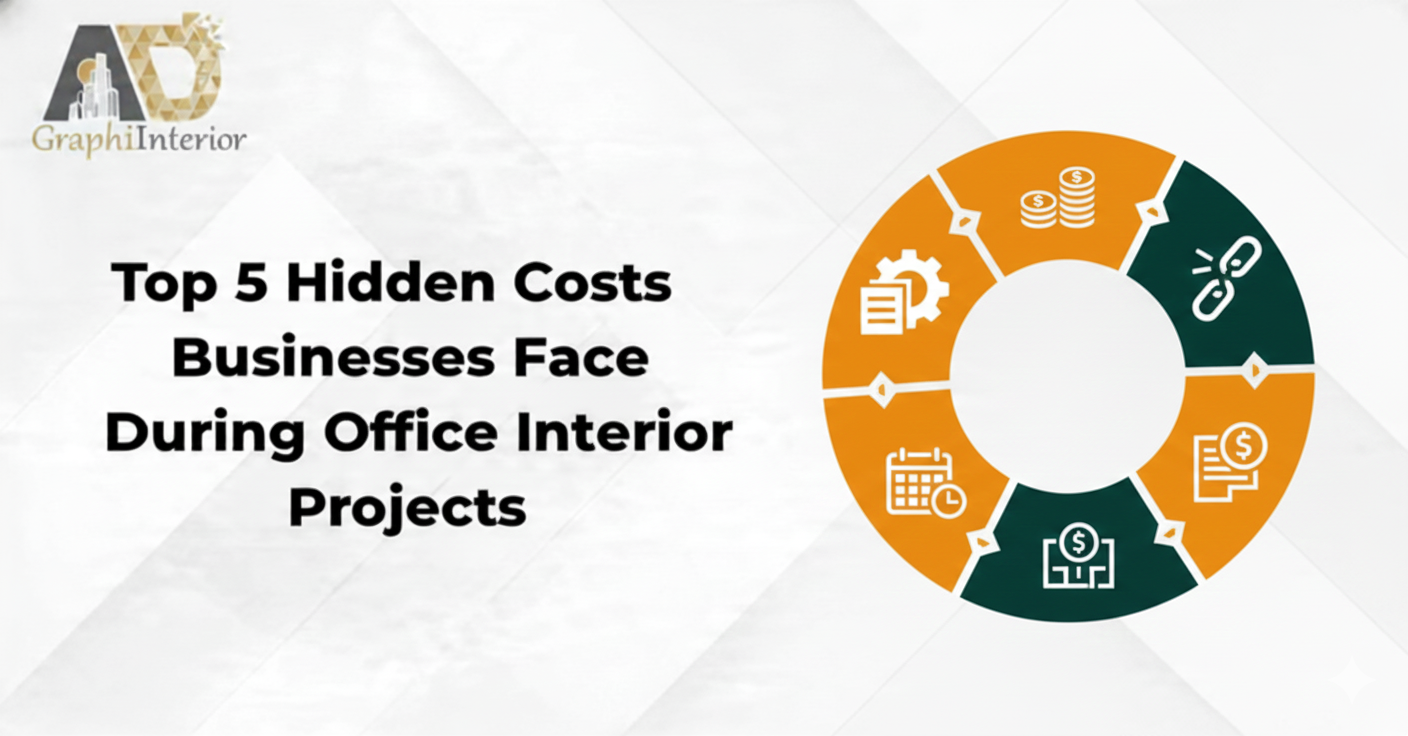
Projects in office interiors are mostly passed due to the shallow cost estimate, where only aspects that are visible, like furniture, flooring, partitions, and interior decor, are taken into consideration. Nevertheless, after the implementation process, most companies find out that interior projects are much more complicated than expected.
The expression of hidden costs emerges slowly, puts a strain on the finances, and interferes with normal operations. Such surprises not only increase budgets but also influence productivity, employee morale, and efficiency at the workplace in the long term. These costs are hidden, but by knowing them in advance, businesses will be able to plan more realistically and prevent expensive surprises.
Why Hidden Costs Are Common in Office Interior Projects
Office interior is not just a design activity, but it is an operating environment that has to serve the people, technology, compliance activity, and expansion into the future. When compliance is the future. compliance, the future. Planning emphasizes the future. Due to the absence of the reality of implementing the idea, the occurrence of hidden costs would be manifested at every level of the project planning.
All these costs are not planned but take place as a result of uncompleted planning, hasty decisions, or the absence of professional coordination. Companies that do not plan for decisions and plan for such costs tend to have high cost overruns, extended work schedules, and impaired functionality in the workplace.
1. Cost of Design Changes After Work Has Started
One of the most costly and disruptive hidden expenses with regard to the project of office interiors is design modification made after the execution. What appears ideal on paper might not be practical when it comes to ceilings and design. Once construction begins, business owners have to adjust the layout of the designs while under construction.
- Large-scale dismantling of partitions, ceiling reconstruction, or furniture.
- Material wastage because ceilings cannot be reused.
- Extra labor costs on re-installation.
- Prolonged schedules that add supervision expenses and overheads.
- Delays the reinstall and postponement of occupancy and operation of offices.
2. Productivity Loss and Operational Downtime
Even planned interior work always intrudes on daily business functions, though it may be in phases. The cost of low productivity is a factor that is not considered when budgeting.
- Reduced the efficiency of employees because of the noise and dust in the construction.
- Meeting interruptions and concentrated work.
- Temporary relocation costs or hybrid working costs.
- Past project deliveries and failure to meet deadlines.
- Stress and dissatisfaction among other staff.
3. Electrical, IT, and Technology Rework Costs
Technology is essential nowadays in the modern office, and the electrical and IT planning is given too late. Lack of coordination between the designer and the technical team will result in duplicated changes.
- Data ports and power points relocation.
- Re-arranging functions, rearranging network cables, and server connections.
- Wiring conversion to increase electrical load.
- Additional costs for AV and conferencing setup changes
- Incompatible with existing hardware and systems.
4. Compliance, Safety, and Approval-Related Expenses
The regulatory and safety requirements are not often taken into account at the design safety stage, which leads to an unpleasant surprise in the form of extra costs when the design is inspected and approved.
- Improved fire safety measures are required following an inspection.
- Modifications needed to conform to the local building codes.
- Other approval and documenting costs.
- Renaissance of designs according to emergency exit standards.
- Fitting of additional safety gear after implementation.
5. Long-Term Maintenance and Replacement Costs
The selection of materials and furniture based purely on the initial cost is likely to incur more costs in the long term. These expenses are not necessarily short-term maintenance, but they have a great impact on long-term expenditures.
- Repairs regularly because of low-quality materials.
- Increased speed of wear and tear of furniture and finishes.
- Maintenance of frequent repainting and refinishing.
- Damaged fittings replacement costs.
- Downtime on maintenance and the productivity of employees.
Conclusion
Hidden expenses within office interior projects would not be found anywhere at any given time, but when combined, they could cause serious budget and business continuity issues. business continuity issues.
Financial risks that most businesses are not ready to pay attention to include design modifications, lost productivity, technology rework, compliance upgrades, and maintenance costs that can be incurred in the long run. The winning office interior project needs to be planned, budgeted realistically, and professionally organized from concept to implementation.
Through early consideration of functionality, compliance, and the ability to be used in the future, businesses will realize unneeded costs and time wastage. This is where the professional interior partners, such as Interiors By AD, come in to add real value, to assist organizations in thinking smarter; costs that would not be noticed are put under control, and efficient, compliant, and long-term growth office spaces are created.