

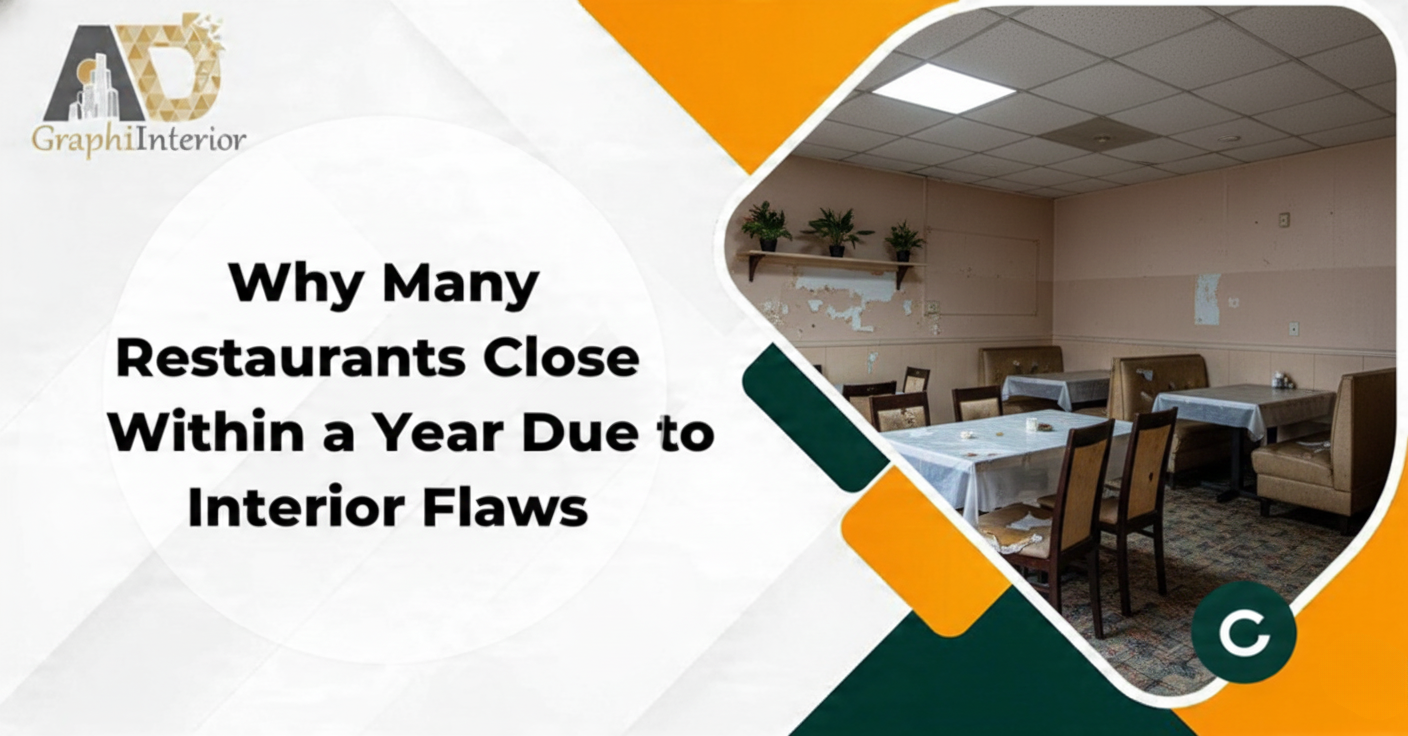
It is true that many restaurants close down in the first year, not due to a lack of quality food or incorrect pricing, but due to a lack of comfort for customers to return. Silently, interior design will determine the experience that people have with a restaurant, their length of stay, and the person recommending the restaurant to other people. In cases where interior planning is ambivalent, duplicated, or based on a superficial approach to the interior rather than function, these approaches can cause long-term operational and customer experience issues. These internal weaknesses slowly diminish the number of people visiting the premises and the brand image and, in the end, push the restaurants out of business.
How Interior Design Mistakes Directly Affect Customer Experience and Sales
Weak First Impressions That Fail to Attract Walk-In Customers
The interior of a restaurant will start selling the experience even before it serves any food. When the space does not capture attention or bring out the concept in a clear way, customers are reluctant to get in.
- Generic and forgettable interiors.
- Themes of designs that are not related to the cuisine.
- Lighting that causes the space to be dull or closed.
Uncomfortable Seating That Reduces Dining Time
Customers can accept average food once, but they will never accept discomfort. The effect of seating includes the duration of stay and the quantity of orders.
- Hard or poorly cushioned chairs.
- Chairs were too close in proximity.
- Lack of comfort due to inadequate legroom.
- Unfriendly seating patterns.
Lighting That Kills Mood and Appetite
One of the strongest, although least understood, interior elements of restaurants is lighting.
- Intense white light that establishes a hospital ambience.
- low lighting that rendered the food unattractive.
- Lights are not uniform, with certain tables neglected.
- No stratified daylighting.
Noise Levels That Create Dining Fatigue
Noise causes loss of repeat business at many restaurants without their awareness.
- Echo due to hard floor and walls.
- No sound-absorbing material employed.
- Noise in the kitchen is spilling to the dining areas.
- Conversations drowned out by music.
Overcrowded Layouts That Feel Stressful
Making efforts to maximize seating usually backfires and chases customers away.
- Tables were overcrowded.
- Small corridors that limit the movement of staff.
- Rushed and uncomfortable customers.
- Loss of privacy during the dinner.
Lack of a Strong Interior Identity
In cases where the interiors fail to tell a story, the customers do not recall the location.
- Lacks no visual association with the brand.
- Non-uniform colors and materials.
- Lack of focal design features.
- Interiors that resemble all other restaurants.
How Poor Interior Planning Damages Operations and Long-Term Growth
Inefficient Layout That Slows Down Service
There is nothing like customer-facing design as much as operational flow. An ineffective design multiplies time wasted and work pressure.
- Kitchen and table distances are long.
- Congested service pathways
Poor billing and service counter placement.
- Higher possibilities of personnel crashes.
Kitchen and Dining Area Mismatch
Kitchen and Dining Area Mismatch is not a rare occurrence, as the kitchen is so small, and the eating area is so small, because there is little space available for them.
Failed back-end design problems are always present in front-end service quality.
- Delays in food delivery
- Overheating of restaurants.
- Customer comfort smell leakage.
- Kitchen noise affecting ambience.
Poor Ventilation and Air Circulation
The room was not well ventilated, and the air was stifling.
Bad air quality may not be an immediate complaint, but it influences the duration of stay of customers.
- Lingering food odors
Redundant heat generation at peak hours.
- Inadequate exhaust systems
- absence of air freshness.
Washroom Design That Lowers Brand Trust
The hygiene standards are usually examined by the customers through the quality of restrooms.
Poor lighting makes the washrooms unhygienic.
- Bad materials, which are easily stained.
- Lack of proper ventilation
- Inconsistency with the dining spaces in design.
Insufficient Storage Creating Visible Clutter
Clutter destroys even beautiful interiors and influences the perception of customers.
- Providing cleaning materials that are visible to the guests.
- Employee personalities in meal areas.
- Overcrowded counters
As a result, temporary storage is spoiling aesthetics.
Rigid Interiors That Cannot Adapt Over Time
Restaurants are forced to change, yet their interior should not be changed badly.
- No flexibility in the layout of fixed furniture.
- Events and special seating spaces are not provided. It is challenging to renovate in difficult ways.
- Failure to scale the operations.
Ignoring Customer Psychology in Design
In interior design, there is a subtle means of controlling customer behavior and spending.
- Low temperatures decrease comfort and time of stay.
- Fast-food-type designs where people can stay and eat.
- No cozy family or group spaces.
Poor zoning interferes with movements and flow.
Conclusion
A large number of restaurants have failed within a year, since interior design is perceived as a tourist feature rather than a business plan. The internal weaknesses are slowly influencing customer comfort, personnel performance, brand memory, and performance, hence dwindling footfall and revenue. An effective interior design of a restaurant balances the ambience, functionality, customer psychology, and operational flow. Careful consideration of seating, lighting, acoustics, ventilation, storage, and brand identity is what results in survival in a competitive market. In this case, the competent design partners, such as Interiors By AD, really stand out in designing the restaurant interiors to ensure that they not only appear attractive but also facilitate the smooth running of the restaurants, customer retention, and long-term sustenance of the businesses.